We were all saddened by death of Dalvanius on the 3rd of October, 2002. He made great contributions to his Patea community, to Maori culture, and to our national identity. Poi-E was his way of giving courage and inspiration to confused young urban Maori.
Intro - chanted by lead female Kaea. TE POI ! PATUA TAKU POI PATUA KIA RITE PA-PARA PATUA TAKU POI E ! E A E rere ra e taku poi poro-titi E B Ti-taha-taha ra whaka-raru-raru e E A Poro-taka taka ra poro hurihuri mai E B E Rite tonu ki te ti-wai-waka e A E Ka pare pare ra pī-o-o-i-o-i a A E Whaka-heke-heke e ki a kori kori e A E Piki whaka-runga ra ma mui-nga mai a A B E Taku poi poro-titi taku poi e E Poi E whaka-tata mai A Poi E kaua he rerekē B Poi E kia piri mai ki au E B Poi E-E awhi mai ra E Poi E tāpeka tia mai A Poi E o taua aroha B Poi E pai here tia ra E POI... TAKU POI E! Repeat solo a cappella : Chanted by lead female Kaea. PATUA TAKU POI PATUA KIA RITE PA-PARA PATUA TAKU POI E ! Verse & chorus repeated again, same sequence. Instrumental break, usually poi percussion. Then key change : repeat chorus on key change. At end of song : POI... TAKU POI E ! 4 times Then everyone chants at song's end : RERE ATU TAKU POI TI TA' TAHA RA WHAKARUNGA WHAKARARO TAKU POI E! |
I had three sources for these lyrics:- the CD recording, Spittle's book Counting the Beat, and an e-mail from Dalvanius. There are some variations in spelling and arrangement of the three sources. I have broken up long words with hyphens to help young singers read them. What is sung as pi-o-o-i-o-i a and TA' TAHA RA is written as pioioi a and taha taha ra. (JA)
A protective symbol
| E
rere ra e taku poi porotiti Tītahataha ra, whakararuraru e Porotakataka rā, poro hurihuri mai Rite tonu ki te tiwaiwaka e Ka parepare ra, pīoioi a Whakahekeheke, e kia korikori e Piki whakarunga ra, ma muinga mai a Taku poi porotiti, taku poi e! Poi E, whakatata mai Poi E, kaua he rerekē Poi E, kia piri mai ki au Poi E, e awhi mai ra Poi E, tāpekatia mai. Poi E, ō tāua aroha - - Poi E - paiheretia ra. POI... TAKU POI, E! |
Swing out rhythmically, my feelings lean out beside me, so deceptively. Swing round and down, spin towards me just like a fantail. Swing to the side: swing to and fro zoom down, wriggle, climb up above, swarm around me my whirling emotions, my poi, Yeah! Oh my feelings, draw near, Oh my poi, don't go astray Oh my affections, stick to me Oh my instincts, take care of me Oh my emotions, be entwined around me. Oh poi, our love... Oh poi ...binds. Poi.... my poi, yeah! |
Ngoi also said she likened the poi, which is like the fantail that flies through the forest, to Maori youth trying to find their way in the concrete jungle of the Pakeha. Just like the fantail which has to flit between trees and leaves, Maori youth have to flit between skyscrapers, both concrete and cultural, and still search for identity.
How Poi-E was written
The whole Poi-E concept was born in 1982 after linguist Ngoi Pewhairangi asked musician Maui Dalvanius Prime how he would teach the younger generation to be proud of being Maori and Kiwi. He told her he could do it by giving them their language and culture through the medium they were comfortable with.Dalvanius was playing at nearby Ruatoria, in between Maori language studies at Wellington Polytech: "I went to visit her and we hit it off," he said. "She said the only way you'll learn about the Maori language is if you stick around on the marae and come with me."
"You stick around on the marae and come with me,"
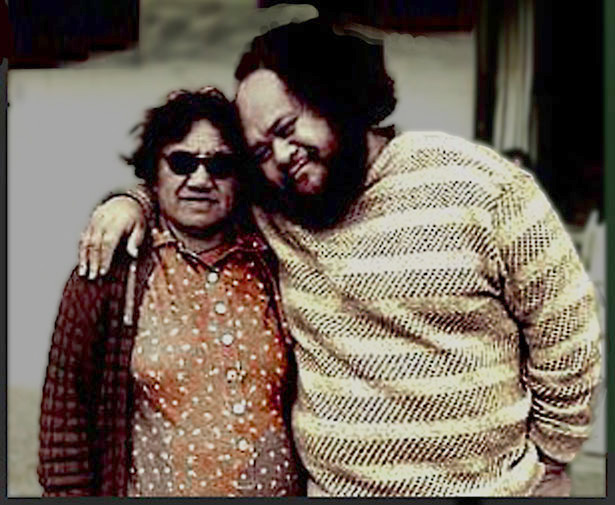
Ngoi with Dalvanius in 1982
© Te Papa Museum (Dalvanius Prime Collection)Ngoi's husband Ben recalls, "In 1982 Maui Dalvanius Prime walked into my home in Tokomaru Bay. On that day I knew our lives would never be the same. I watched my late wife Ngoi. She was the tutor, her student wide-eyed and eager to learn about maoritanga. I recall their days and nights together, kaiako and tauira, immersed in their work, oblivious to the existence of anyone else."
Dalvanius had intended a weekend stop - "She wanted to write a couple of songs and I said I can only spare one day" - and instead left four weeks later with twelve songs for an opera written with Pewhairangi. Prime would provide ukulele - "I write all my songs on a ukulele" - and some piano for developing the arrangement: "She had this rickety old piano which I banged out a few things on. She'd write words as fast as I sang her the melody lines. Working with Ngoi Pewhairangi was such a blessing."
Dalvanius, self-taught and an ear musician, would notate the songs using bar charts - "I can't be bothered with dots. I would hire a musician to do that."
In their first day they wrote Poi-E, Aku Raukura and Hei Konei Ra, Dalvanius reworking old Fascinations grooves and Pewhairangi providing lyrics. "I could hum a tune and she could write Maori words and phrases which were exactly the same as the tune. I would tap out the dots on the piano and she would write a short or long word accordingly."
Record companies turned down his production of Poi-E by the Patea Maori Club :- "They all said you've got to be joking, no one would listen to this." Ngoi also rejected initially the Pot-E demos which had been recorded with a bubbling disco synth backing.
Dalvanius (rear) with the Patea Maori Club - Te PapaSo Dalvanius formed his own record production company Maui Records. His vibrant production of the Patea Maori Club singing Poi-E became a huge hit and was 22 weeks on the NZ hit charts in 1984, charting at number 1 for 4 weeks. It was also a big hit overseas, Dalvanius taking the Patea Maori Club on a tour which included The London Palladium, the Edinburgh Festival and a Royal Command Performance.

Marketing Maori culture
Dalvanius decided Poi-E was about marketing the Maori language: "I told Ngoi of my personal life experience of growing up in Patea in an environment void of any indigenous heroes or icons, Maori or Kiwi."I asked her who her favourite singers were. She replied, Perry Como and Frank Sinatra. I confessed I was a Motown/Beatles/Rolling stones fanatic and had grown up in a household full of music by Elvis and posters of James Dean. I then asked her, what did all these singers and stars have in common? For me, their entire persona - fact and fiction - was a perfectly managed marketing exercise.
"We designed Poi-E using that marketing strategy. Apart from a calculated urban consumer-oriented publicity campaign, Poi-E's strength was it's rural roots, the promotion of Te Reo Maori, the Maori language and Kiwi culture. Long after her and I have left our earthly bodies, the language - via our anthem - will live on from generation to generation.
"Ngoi asked me how I would describe what I have done. I said it is a hybrid of our rural roots and urban influences. This sound was a product of the urban drift when our rural jobs were lost and she agreed with me."
Poi-E: the Musical
The songs, telling the story of how the Maori community in Dalvanius's little township was affected when the factory there was closed, were expanded into a musical.Dalvanius again; "When we wrote the musical it was about what happens to a group of people who leave Patea, what happens to them when they go into the urban environment and try and make a living. Looking at the lyrics and translations they were all about identity and Maori seeking their heritage."
Dalvanius was born and brought up at Patea, a small west coast village between Wanganui and New Plymouth which was dependant for jobs on the big freezing works. (The works had opened in 1883, canning meat for export. It started freezing meat in 1904) When "The Works" closed in 1982 there was huge social disruption, and young Maori people had to leave their close-knit marae and head for the cities to find work.
Some could not cope with the loss of communal support and were destroyed by prostitution and drugs. The Poi-E musical tells this story, and how the Patea community coped with the problem.
Read the full story of Poi-E: the Musical on Dalvanius's own web site. CLICK HERE
Poi-E on record
- 1984 Patea Maori Club 45
Purchasing details - Click- 1987 Patea Maori Club LP
E pa to hau
Ko Aotea
Taranaki patere - Kahuri
Parihaka-Tewhiti-Tohu-Tawhiao
Nga Ohaki
Ngakau maru
He konei ra
Ngoi Ngoi
He tangata tina hanga
E papa
Aku Raukura
Poi-E.- 1996 Patea Maori Club CD
- 1995 New Zealand Our Land Our Music CD
- 1997 New Zealand singalong CD
- 2002 Nature's Best 2 CD
- 2004 Poi E / Man Of Passion CD

Maui
Carlyle Dalvanius Prime, 1948-2002
Tainui, Ngapuhi, Ngati Ruanui, Tuwharetoa,
Nga Rauru, Pakakohi and Ngai Tahu
Maui Karawai Parima (Maui Carlyle Prime) was born and raised in Patea, where he grew up with seven brothers (one adopted) and four sisters, in conditions he once described as "rough." His father Ephraim (known as Jack), a freezing worker, played numerous instruments, and his mother Josephine was a talented singer.His father was a returned serviceman and wanted to name Maui after a fellow soldier called Dalvanius who had died in Barletta Hospital in Rome. Although it didn't get onto his birth certificate, the name stuck, (and the name Barletta was given to Maui's younger sister).
He recalled the indifference and antagonism to Maori culture in his childhood years. "Every weekend we went to the Pa; but I wasn't interested. I didn't want to be in the haka; I was into doo-wop groups and Phil Spector. And at school we weren't allowed to speak the Maori language. Patea was such a redneck town in the 50s ."
Brought up as a Mormon, he attended the Latter Day Saints College in Hamilton, but he found the traditional music training there very irksome, and was suspended for playing rock and roll music on the school's church organ.
Growing up in a household full of music by Perry Como, the Inkspots and Elvis, and later by the Beatles, Rolling Stones and Motown, young Maui started a career as a singer and musician in an Beatles-imitation group around Taranaki dance-halls and marae.
In 1969, he teamed up with his two brothers Eddie and Timothy and his sister Barletta to form "The Fascinations," and they won a talent quest at Wellington's 2ZB radio station. He then joined a group of three Mormon women from Porirua called the Shevelles, but later "The Fascinations" regrouped and they toured throughout Australasia, the group becoming known as "Dalvanius and the Fascinations."
He was composing songs in Australia in the black American soul format, but was advised to return to New Zealand and produce works from his own cultural background. This was how he came to produce his wonderful version of Tui Teka's E Ipo. (He cajoled Tui Teka into recording the song at 1 am, when Tui was very tired) He asked Tui Teka who had written such great lyrics for E Ipo, and Tui told him "Ngoi Pewhairangi."
So in 1982, while performing at Ruatoria, he visited Ngoi at nearby Tokomaru Bay, and they inspired each other to write songs which would give indigenous Kiwi heroes and icons to young Maori growing up in a culturally alienated environment, like the environment young Maui Prime been raised in.
Their song Poi-E became a runaway hit record in 1984, and Ngoi and Dalvanius started working on a musical telling of the impact on the Patea people of the closing of the freezing works there and how Ngoi's songs helped inspire them. The Patea Maori Club took this on a world tour in 1986.
By the late 1980s Dalvanius was composing and producing music for film soundtracks, (Ngati and Te Rua) and helping to set up the Maori radio network, "Aotearoa Radio."
Dalvanius knew he had to market the Maori language and culture in a rescue mission to alienated young Maori. So he worked to develop Poi-E legends, Poi-E animated films, Poi-E action dolls, Poi-E children's games, Poi-E clothing and more.
Click for more picsHe became a guide for young people involved in court cases and domestic violence, striving to get them job training. He himself ran courses teaching young Maori all facets of the music industry, including performance skills and self-promotion.
In 1990, after seeing preserved Maori heads in a museum in East Berlin, he bacame a tireless campaigner for the return from overseas of these moko mokai. FULL DETAILS
A very big man himself, he had a passion for the miniature. Chihuahua dogs and prize-winning silver-faced Wyandotte chickens were his pets.
When I contacted Dalvanius in September 2001 for permission to make a Poi E web page he wrote back, in large capital letters:
TENA KOE HONE, OF COURSE YOU HAVE MY PERMISSION. YEAH IVE HAD A BUMMER YEAR A CANCER SCARE AND ALL THAT BUT IM OVER THE WORST PART OF IT AND ITS BACK TO WORK. I WAS ONE OF THE MANY WHO WAS EXPOSED TO THE EXTRA GOD GIVEN TALENTS OF NGOI AND THRU HER HER GRAND AUNT TUINI NGAWAI. THE PROJECT SOUNDS EXCITING, CONGRATULATIONS.Later he e-mailed that he was not expected to live past February 2002. But he had too much to do to die then. Despite the lung cancer, he got back to work helping produce a book of Ngoi Pewhairangi's songs and continued to work to have moko mokai returned. In August 2002 he was awarded a special award from Te Waka Toi, the Maori section of Creative New Zealand, for "leadership and outstanding contribution to Maori arts."He died in Hawera on the 3rd of October 2002, aged only 54, having made an enormous contribution to his Patea community, to Maori cultural heritage and to our national identity.
He is buried with other family members in front of Tutahi Church, Nukumaru, (3165 State Highway 3), a few kilometres south of Patea. For more details see the Dalvanius Resume on the Digitalus website, and get a cassette copy of the July 2000 Musical Chairs interview with Dalvanius from Replay Radio.

Ngoi Pewhairangi 1921-1985
Born Ngoingoi Ngawai in Tokomaru Bay, where she was raised in the Ringatu faith by relatives.
Her primary schooling was at Tokomaru Bay Native school. Her first language was Mäori but she quickly became literate in English. Later, from 1938 to 1941, she attended Hukarere Mäori Girls School in Napier.
After leaving school she returned to Tokomaru Bay and worked for her aunt, Tuini Ngawai, in her shearing gang. Also during this time she competed in many hockey/kapa haka tournaments around the North Island.
She was a member of the Te Hokowhitu-a-Tu concert party which her aunt, Tuini Ngawai, founded in 1939 to raise money for the war effort. Ngoi was groomed by Tuini in performance, composition and leadership, and she later tutored and led the group on many occasions.
Ngoi speaking at the 1982 Weavers' Hui,
Pakirikiri Marae, Tokomaru Bay.In 1945 she married Ben Pewhairangi, a Tokomaru Bay farm worker.
In the 1970s Ngoi taught Mäori language and culture at Gisborne Girls High School, and later began tutoring for the University of Waikato's certificate in Maori studies. Her skill in motivating people regardless of race, age, gender, or occupation was soon recognised, and by 1977 she was asked to work in the Tu Tangata program, rescuing alienated urban Maori youth.
In 1975 she helped develop the Te Ataarangi tv method of teaching the Maori language using Cuiseinaire rods. In 1983 she brought together skilled Maori and Pacific Island weavers for a week at Tokomaru Bay and formed the Aotearoa Moana Nui a Kiwa Weavers.
Ngoi was considered an expert on adjudicating kapa haka competion, she was frequently called upon to judge them. She composed many songs such as Kia Kaha Nga Iwi, Ka Noho Au, and Whakarongo. She was renowned for the spontaneitity of the compositions she wrote for many people, such as Poi-E which she wrote for Dalvanius Prime.
She wrote E Ipo for Prince Tui Teka when he came courting Missy, who lived up Ruatoria way, so that he could sing of his overwhelming love for her.
When Ngoi died at Tokomaru Bay in 1985, she was revered for her unstinting advancement of the Maori language and culture and for her ideal of a bicultural nation in which Pakeha would help to ensure the survival of the Maori language.
Summarised from an article by Taania Ka'ai in The Dictionary of NZ Biography.
Other Maori Songs - Main Song List - Home
Published on the web, 4nd Oct 2002, modified 5 April 2005
