NZ
soldiers in Singapore introduced Prince Tui Teka to this
popular Indonesian love
song,
and
Ngoi Pewhairangi wote these Maori lyrics for Tui Teka to
sing to his wife Missy.
Ki a
koe te tau
?ku mihi e.
Ahakoa haere koe ki hea
maku r? koe e whai atu e.
Ko taku aroha
ka ? tonu.
T?na ra e hine
huri mai r? ki ahau e tau nei
hei, utanga atu,
e Ipo.
Otir?, e hine,
ku-a tau-nga k? t?nei tinana,
a-ue, ki te aroha
e Ipo. (E. I. P?)
My darling Missy
You are always on my mind
Wherever you may go
You take a part of me.
My love for you is endless
Keep me always in your heart
For you are a special part of me.
My never-ending love.
T?na ra e hine
huri mai r? ki ahau e tau nei
hei, utanga atu,
e Ipo.
Ki te aroha e Ipo.
To
you, my darling
my greetings.
No matter where you go
I will follow close behind.
My love
will remain firm.
Come my
brloved,
turn to me your
spouse
here
and I will support you
my
darling.
Indeed, beloved
my whole self is at home,
Oh yeah! with your love
my darling.
(Eh! At night!)
Come
my
beloved,
turn to me your
spouse
here
and I will support you
my
darling.
Oh
your love my darling.
E Ipo tune
C
Ki a kwe te tau
?-ku G7 mi-hi-i
A-ha-kwa ha-e-re kwe ki C
he-G-a C Ma-ku r? ko-e e
fai G a-tu e.
Ko ta-ku a-ro-ha
ka ? C to-nu G7
C T?-na F
ra e hi-ne G hu-ri mai r?
ki a-hau e C tau
nei F hei, u-ta-nga
G7 a-tu,
e I-po C - G7
C
O-ti-F-r?, e
hi-ne, G ku-a tau-nga
k? t?-nei ti-C-na-na,
F a-ue,
ki te a-G7-ro-ha
e I-po C
These
syllables and guitar chords are as Tui Teka sang the song.
Notice that "mihi e" is sung here as mihi-i, while
"koe" is sometimes sung as kwe and at other times as
ko-e. Also "Ahakoa haere" is sung as A-ha-kwa
ha-e-re.
The tune used is borrowed from a love song Mimpi
Yang Sedih. Although this was composed in Indonesia,
by band-leader A. Riyanto in 1972, the first place it became
very popular was Malaysia, when it was sung there by
Taiwanese singer Teresa Tang. Rei
Isaacs told me that the kapahaka group of the 1RNZIR
soldiers based in Singapore quickly added it their
repertoire as "The Malaysian Love Song".
Tui Teka visited Singapore during his 1980-82 tour of the
Hilton Hotel entertainment circuit, and at an opportune time
soldiers from from the kapahaka group and some families went
up to mihimihi him. In that process they sang this song to
him.
A little while later, when Tui Teka met Ngoi Pewhairangi
while courting Misssy, Ngoi wrote Maori lyrics to its tune
for him.
Record
producer Dalvanius Prime told me that he had some problems
with the Indonesian Embassy and the composer before they got
permission to use it when E Ipo was first recorded in 1982.
Mr
Dennis Marsh has kindly given permission for use of MP3
clips from his Out of New Zealand CD.
Dennis is a Country & Western singer, and consequently
sings this song in the key of G.
1. Kia koe te tau MP3 140
K.
2. Tena ra e hine MP3 70 K.
3. Oti ra e hine is the same tune as 2
Mimpi Yang
Sedih
Di
dalam sepi aku bermimpi
Mimpi yang sedih sekali
Kau akan pergi tinggalkan diriku
Aku menangis tersedu
On
a quiet night I dream
the bluest dream.
You are going to leave me all alone
I cry and sob.
Diriku
tak pernah
Lepas dari penderitaan
Impian ini terjadi
Kau pergi setelah
Aku serahkan kasih suci.
Itulah nasib diriku.
I
will never
escape from the suffering
This dream is so real:
You are going away after...
...I have given you my pure love.
That is the fate of my life.
1983
Prince Tui Teka, The man, the Music, the Legend, LP
1990
25 years of Kiwi pop
1992
Golden age of Maori song
1995
New Zealand: our land, our music
1996
Kiwi gold disc. 4
1996
New Zealand Maoris ; 20 favourite songs
1996
Prince Tui Teka, The Man, the Music, the Legend, CD
When this recording was re-issued as a CD, Ngoi's name
was spelt Ngoi Pewhai Rangi
and the song was spelt E. I. Po (Oh that
night), a play on the words E Ipo (Oh darling).
Born
Ngoingoi Ngawai in Tokomaru Bay, where she was raised in
the Ringatu faith by relatives.
Her
primary schooling was at Tokomaru Bay Native school. Her
first language was M?ori but she quickly became literate
in English. Later, from 1938 to 1941, she attended
Hukarere M?ori Girls School in Napier. After leaving
school she returned to Tokomaru Bay and worked for her
aunt, Tuini
Ngawai, in her shearing gang. Also during this time
she competed in many hockey/kapa haka tournaments around
the North Island.
She
was a member of the Te Hokowhitu-a-Tu concert party which
her aunt, Tuini Ngawai, founded in 1939 to raise money for
the war effort. Ngoi was groomed by Tuini in performance,
composition and leadership, and she later tutored and led
the group on many occasions. In 1945 she married Ben
Pewhairangi, a Tokomaru Bay farm worker.
In
the 1970s Ngoi taught M?ori language and culture at
Gisborne Girls High School, and later began tutoring for
the University of Waikato's certificate in Maori studies.
Her skill in motivating people regardless of race, age,
gender, or occupation was soon recognised, and by 1977 she
was asked to work in the Tu Tangata program, rescuing
alienated urban Maori youth.
Ngoi speaking at the 1982 Weavers' Hui,
Pakirikiri Marae, Tokomaru Bay.
In
1975 she helped develop the Te Ataarangi tv method of
teaching the Maori language using Cuiseinaire rods. In 1983
she brought together skilled Maori and Pacific Island
weavers for a week at Tokomaru Bay and formed the Aotearoa
Moana Nui a Kiwa Weavers.
Ngoi
was considered an expert on adjudicating kapa haka
competion, she was frequently called upon to judge them.
She composed many songs such as Kia Kaha Nga Iwi, Ka
Noho Au, and Whakarongo. She was renowned
for the spontaneitity of the compositions she wrote for
many people, such as Poi E which she wrote for
Dalvanius Prime.
She wrote E Ipo for Prince Tui Teka when he
came courting Missy, who lived up Ruatoria way, so that he
could sing of his overwhelming love for her.
When
Ngoi died at Tokomaru Bay in 1985, she was revered for her
unstinting advancement of the Maori language and culture
and for her ideal of a bicultural nation in which Pakeha
would help to ensure the survival of the Maori language.
Summarised
from an article by Taania Ka'ai in The Dictionary of NZ
Biography.
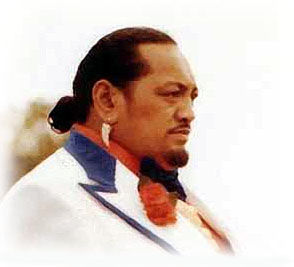
Prince Tui
Teka
Teka was from Ruatahuna in the Ureweras, and had a musical
childhood. His mother played mouth organ and clarinet, and
his father was a saxophonist with a bush band. After
learning guitar and saxophone at woolshed dances with
teenage bands, Teka moved to Sydney and began a six-year
stand with the Maori Volcanics showband on the Japan and
Pacific circuit. The 'Prince' title was adopted when Teka
joined the Maori Troubadours: 'In those days Elvis was the
king of rock'n'roll so we thought up New Zealand's prince
of entertainment.'
In the 1970s Teka performed solo in Sydney and southeast
Asian clubs, his extravagant stage wardrobe including
rhinestone jackets and embroidered shirts cut for his one
hundred and forty kilogram frame. His cabaret set was
enlivened with downhome jokes: Nat King Cole ('I'm his
half-brother Charcoal'). His over-sized choreography added
to the fun, as Teka found later when he dieted down forty
kilograms on medical advice: "I had no stomach to wiggle."
Missy joined the show after their marriage in 1976. Teka
would appear on up to ten instruments- "Middle of the
road," he said, "a couple reggae numbers, a couple country
and western, rock'n'roll impressions and playing different
instruments."
By 1981 he had returned to Tokomaru Bay ('I began to feel
homesick') and became a household name during the next
year with E Ipo, and two albums with Teka originals
including Real Love and Oh
Mum. He appeared in films, including Came
A Hot Friday and Savage Islands, in which he
featured as a cannibal chief.
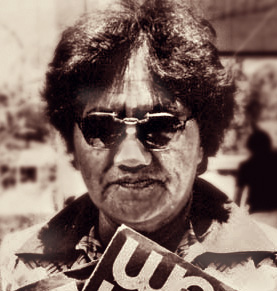 Born
Ngoingoi Ngawai in Tokomaru Bay, where she was raised in
the Ringatu faith by relatives.
Born
Ngoingoi Ngawai in Tokomaru Bay, where she was raised in
the Ringatu faith by relatives.