|
This song was written in New
Zealand when shore whaling ended here in the early 1960s. It
is a cleverly-constructed "tall story" based on an authentic,
but rather dreary, 1820s US whaling shanty. The Wellerman in this song refer
to one of the ships owned by Weller Brothers of Sydney. These
ships supplied food, clothing and whaling equipment from their
base at Otakou to shore whaling stations in sheltered
New Zealand harbours, not to ships at sea.
 A 500-year Folk Process This song is derived from the
traditional 1635
broadside ballad "The
Golden Vanity," about a heroic young crewman who stopped
an enemy galley from ramming
Sir Walter Raleigh's ship and sinking it.
There
was a gallant
ship, and a gallant ship was she
And the name of the ship was the Golden Vanity Sailin’ on the low, the lowlands low She sailed upon the lowlands low She hadn’t sailed a league, a league but only three, When she was overtaken by a Spanish gallee Sailin’ on the low, the lowlands low She sailed upon the lowlands low....more There
was a ship sailed on the northern sea
The name of the ship was the 'Green Willow Tree' As she sailed on the lowlands that lie so low, As she sailed on the lowlands low. We had not sailed but a league or three Till we were overtaken by the Turkish Revelee, As she sailed on the lowlands that lie so low, As she sailed on the lowlands low......more He became famous after surviving about a hundred whalers' attacks and drowning a hundred or more whalers. He was quite docile, but once attacked he retaliated with ferocity and cunning, sinking 20 whaling ships and dozens of whaleboats. 1.
There was a ship that sailed the sea,
The name of the ship was the William of Tyre; The winds blew high,The winds O blow, my bully boys, blow! 2. She had not sailed a week, a week, A week but barely three, When there she spied a great white whale, O blow, my bully boys, blow ...... 3. Come raise your hands, my bully boys, And swear you'll not flinch nor fear; While there's a spar to keep afloat, |O blow, my bully boys, blow! 4. The boat was launched, the crew aboard, The whale was straight ahead; And through the foam and through the spray, O blow, my bully boys, blow! 5. The mate he stood in the bow of the boat, His lance was in his hand; The whale he spied the little craft, And he made at it with a roar. 6. He smashed the boat to splinters small, And tossed the men in the air; And some fell here, and some fell there, And some fell in the sea. 7. The captain stood on the quarter-deck, And a melancholy man was he; "Now what shall I do?" the captain cried, "For the whale has wrecked my boat." 8. "Go lower the boats!" the captain cried, "And after this whale we'll go;" But the whale had heard the captain's voice, And he answered from below. 9. "For forty years," the whale he said, "I've sailed in the northern sea; I'm tired of sailing," the whale he said, "And I think I'll go below." 10. He gave a lash with his tail, And he sank beneath the wave; And that was the last of the great white whale, And the ship and the gallant crew
From: The
Forget-Me-Not Songster: Songs Your Grandmothers
Sang, by Frederic A. Brady, 1850. Tune: The
Barry's Old Bullock Dray.
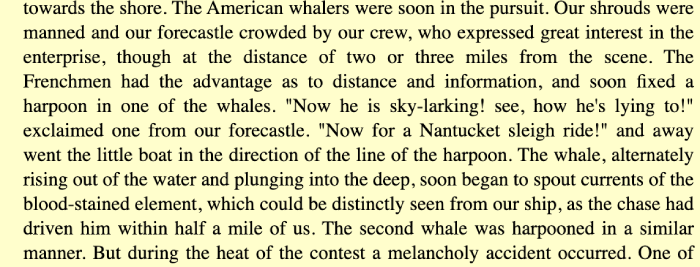
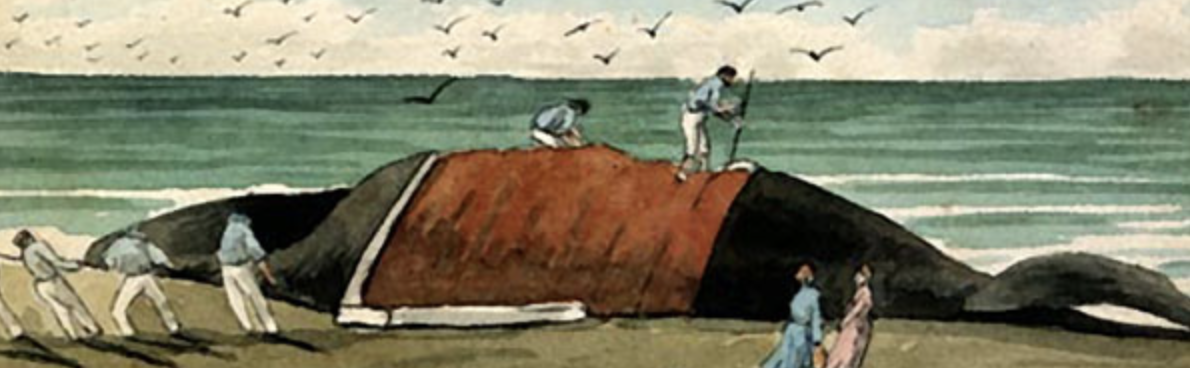
When the crew of a whaleboat harpooned a whale, they were towed for a few minutes at speeds of up to 50 kph. In 1835, journalist Francis Warriner recorded such a chase.
In
December 1964 the last shore whaling
station station in New Zealand closed after 170 years.
There were articles in newspapers about our whaling
here, such as this
one.
Then in 1965,
Tom Paxton's anti-Vietnam war song "Lyndon
Johnston Told The Nation" was being
played and sang in NZ.
At about the same time, New Zealand folk-singer Tommy
Wood discovered that
grim 1820s Mocha Dick whaling shanty in an old
book his school-teacher wife brought home, and
lightened its mood by stretching the story of a
whale boat being towed for a few minutes into an
improbable yarn about a fully-rigged whaling ship
being towed for months - Yeah, right! He
set it to a tune based on Paxton's 'Lyndon
Johnston.'
Helped by songwriter Neil Colquhoun, they then added a Wellers' man verse and chorus to associate the Mocha Dick song with the historical New Zealand shore whaling industry. Tommy started singing it Auckland folk cafes in about 1966. We can tell that the chorus and 6th verse were obviously composed by non-whalers because tonguing, Wellers' man and Wellerman were NOT 19th century whalermen's terms, and because cases of food could not be regularly supplied to a whaler in the Southern Ocean, whose location was unpredictable when it was attached to an unstoppable whale. Our profound thanks go to Dr Michael Brown, who in 2025 located Neil Colquhoun's original 1969 recording of Wellers' man.
In 1970,
the tapes that Neil Colquhoun recorded for the NZBC
were rebroadcast in England.
And in June 1971 the BBC children's TV series 'Follyfoot' came out with a theme song that got much radio play. An upbeat version of the Paxton/Wood Wellerman tune was used for it. Notice that this song has the same 'never give in' theme as Wellerman. Down in the meadow where the wind blows free In the middle of a field stands a lightning tree It's limbs all torn from the day it was born For the tree was born in a thunderstorm. Grow, grow, the lightning tree It's never too late for you and me Grow, grow, the lightning tree Never give in too easily. In
1972, when AH
& AW Reed published a beautifully produced
second edition of his New Zealand Folk
Songs book, Colquhoun added
Wellerman to its whaling section, giving the
song a fake authenticity by claiming he had
collected it from an elderly "Mr Woods," but
using the Follyfoot modification of its tune,
giving rise to the suspicion that the Lightning
Tree's English song-writer, Francis Essex, was
the tune's original composer.
And that, dear
friends, is how the Folk Process works. Whew!
2019 Parody - The Needleman
The
Covid-19 pneumococcal virus killed
millions worldwide in its first year,
including more than 150,000 medical
workers. New Zealand went into lockdown
until vaccines were developed,
mass-manufactured, distributed and
injected.
Substitute your
own frustrated desire at the end of each
chorus.
Our New Zealand leader is PM Jacinta Ardern, but substitute your own leader and your own country's Covid response. Or write alternative (humorous?) verses to evoke your own situation. Some New Zealanders were swayed by American social media and protested the anti-pandemic lockdowns and vaccinations by driving in convoy to parliament in Wellington and staging a long-term protest there,giving rise to Me And Convoy 22 Mau
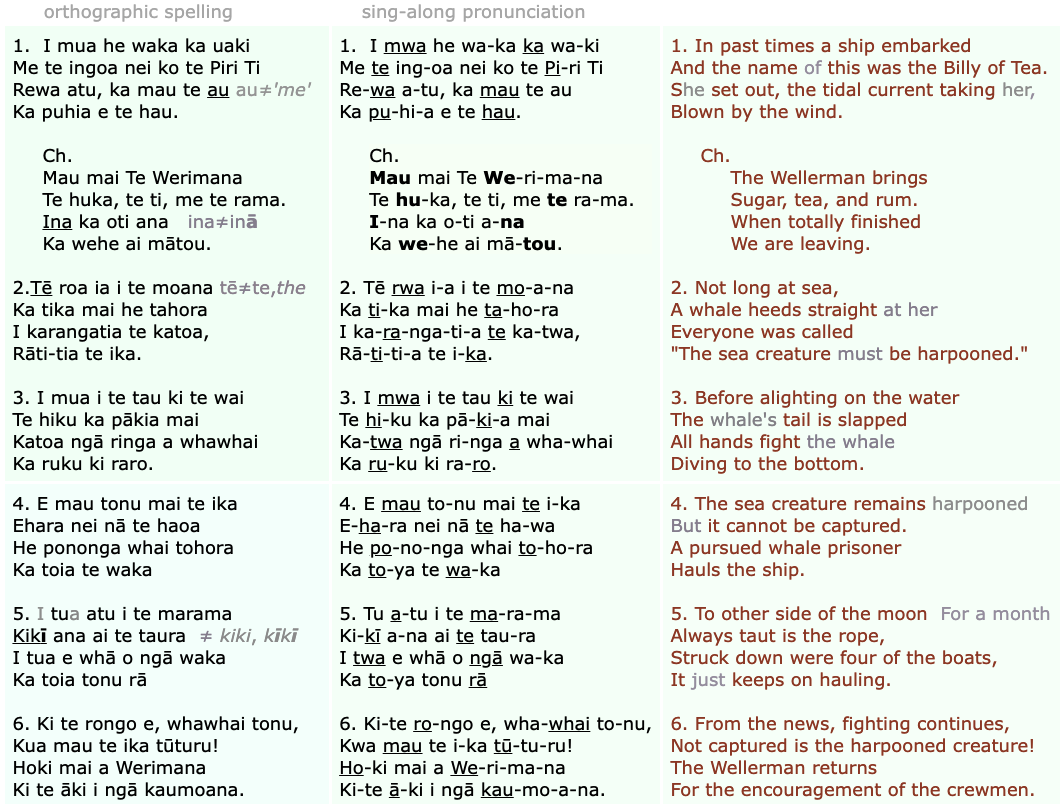
Mai Te Werimana
|
|||||||
 They
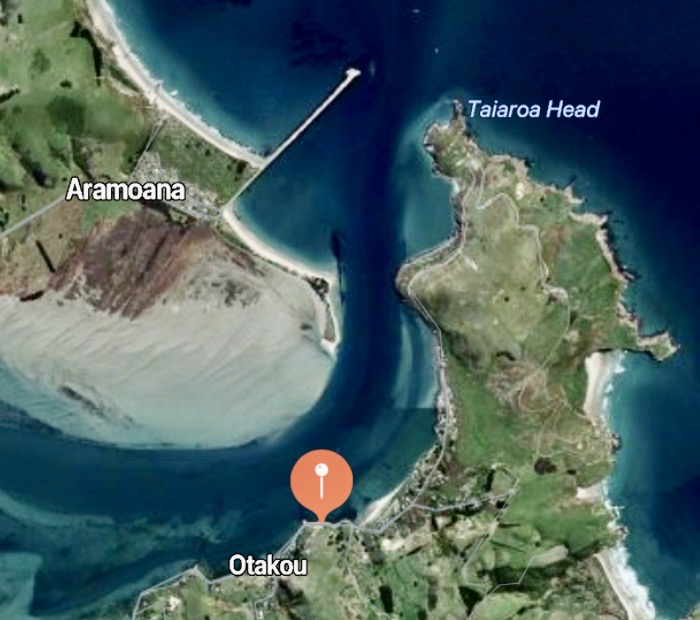
landed in Port Chalmers at a
promontory 'Te Umu Kuri' (which became
known as Wellers' Rock) to the south
of Tairoa Head - and established a
whaling station there.
They
landed in Port Chalmers at a
promontory 'Te Umu Kuri' (which became
known as Wellers' Rock) to the south
of Tairoa Head - and established a
whaling station there. |
-
the Church Missionary
Society had been at the Bay
of Islands since 1814, but
this was 800 nautical miles
north of Otago.
- a Free Church of Scotland settlement was established in Otago in 1848. |
So Edward Weller became manager of Weller's Otakou establishment when he was only twenty years of age. For a few years the business flourished, becoming one of the biggest whaling stations on the New Zealand coast, and did considerable business with calling ships as a general store.
Difficulties began to increase. The number of whales using those coastal waters became fewer in number; opposition from other whalers became more severe; there were difficulties over land possession, both with the local Maori and also with the New Zealand Government. In 1840 Edward Weller returned to Sydney due to to ill health and did not return.
A Shore-whaler's Memories
"I came to Otago in a brig named the Micmac, and landed at Otago on the 17th March, 1836 (St. Patrick's Day). The very day after we landed, they killed a couple of fair sized whales right up in the harbour. They were the first whales I ever saw killed. The boats were not away more than twenty minutes before they had them both, and they were killed in a twinkling...." More
Dr Edward Pohau Ellison, OBE
Edward Weller's grandson, Edward Pohau Ellison, had a long and faithful career as a Medical Officer and Public Servant in the Pacific Islands.
Edward's paternal grandfather, Thomas Ellison, had left his home in England as a cabin boy on one of the East India Company's boats, settled in Australia and later went whaling in Otakou, and then established his own whaling station further to the north in the Malborough Sounds. He married Ika-i-raua, daughter of the chief Whati of the Ngati-Tama. After Thomas was drowned in a storm at sea, his whaling station was taken over by a son, Raniera Ellison.
At the same time, at the Weller brothers whaling station at Otakou, Edward Weller's first wife Paparu died, and he then married Nikuru Taiaroa, who also died, after giving birth to her first child, Hannah Nani Tairoa Weller.
Raniera Ellison gave up whaling for goldmining, and in later years he married Hannah Weller. They moved to a farm near Otaki, where Edward Ellison was born, and after many difficulties, graduated in medicine at Otago University. Te Hou
.............
...........Te Whati
...............|
....Te Ikairaua m. Thomas Ellison
......................|
Matenga Taiaroa m. Hinewhareua
.........................|
......... Nikuru Taiaroa m. Edward Weller
......... .......................|Raniera Ellison .............m. ....... ....Hannah Nani Weller
| ......
.Edward Pohau Ellison..........
Maude Gonne's version
This version was also picked up by the Pioneer Pog'n'Scroggin Bush Band.
|
Mike Moroney writes;
"The fiddle player in the Pog band at that time was Tarek Bazley (whom you hear interviewing auspicious people on National Radio these days). Tarek was also a member of a fantastic, yet rough-as-guts, originals band called Maud Gonne that had a strong celt-folk feel to them. We picked up that version of Wellerman pretty much as is from Tarek's band."
"Wellerman" on record
1975 Phil Garland, Colonial Yesterdays, (LP)
1977? Cant. Crutchings Bush and Ceilidh Band, Landfall New Zealand (cass.)
1977 Irish Rovers, "The Irish Rovers in New Zealand" (NZBC Program)
1994 The Maud Gonne Band, The Difficult Third Album (LP) - changed lyrics
1985 The Morgans, Soundings for the Whale Conn. USA, (cass. )
1995 Bok, Muir & Trickett, And So Will We Yet Maine USA, (cass. CD)
1998 Pioneer Pog n' Scroggin Bush Band, Sesqui (CD) - changed lyrics
1998 Whole Peeled, Induce (CD) - changed lyrics
1998 Mike Harding, Past to the present (CD)
1999 Bill & Kath Worsfold. New Zealand Tour. (CD)
2003 The Maritime Crew, Under the Southern Cross (CD)
2005 Bruce Paine, Guitar@museum (CD)
2007 The Marit. Crew & Folgearster Folk, On The Road Together, Holland (CD)
2010 The 2009/10 NZ Secondary Students' Choir in concert. (CD)
2013 Wgtn Sea Shanty Society, That's What I Call Sea Shanties 1 (CD)
2014 The Maritime Crew. Under the Southern Cross (CD)
2016 The Maritime Crew. Rolling the whole world round. (CD)
2018 Rhodeworks. Unrealistic expectations. (CD)
2018 Song of a young country (CD)
2018 The Longest Johns, Between Wind and Water. Spotify (CD?)
2018 Wgtn Sea Shanty Society, Ahoy. Spotify (CD?)
Kiwi Songs - Maori Songs - Home
Page published on the internet 9th Sept 2002, family tree added June 2006, updated 2021, Werimana added April 2023, corrections made November 2025, source of Wellerman tune added Jan 2026.