
| Mangamahu |
|
|---|
|
Mangamahu todayThe Mangamahu District is a hill-country farming and forestry community in the middle reaches of the Whangaehu River valley, 50km north-east of Wanganui, NZ. It is centred on the village of Mangamahu, which is situated on river flats where the Mangamahu stream flows into the Whangaehu river. Mangamahu
has a well-regarded primary school (25-30 children in
2006) which has been open since 1894, and a War
Memorial hall built in 1952. Early history
The river flat on which Mangamahu School is situated is the site of an old Ngati Apa camp-site named 'Kohanga.' This was occupied in summer by bird-snaring and eel-trapping groups, and by those traveling the "Upokongaro" trail up the ridge between the Whangaehu river and Mangamahu stream, from the fortified pa at 'Manumanu' (near the mouth of the Mangawhero river) to Karioi, and then across the Rangipo Desert and Lake Taupo to the Waikato and Rotorua. Kohanga and Manumanu were destroyed during the musket wars in 1840 and 1843, and most of the surviving inhabitants of the upper valley moved west to Parikino on the Wanganui River. British colonists began buying the land in the 1870s. James MacDonald was the first white settler, introducing sheep to his clearing in the bush at 'Glenaladale' in 1872. His wife joined him there in 1875. The old Maori trail "Upokongaro," first used by Paerangi and his followers 700 years ago to colonise the Waimarino plains, followed the Whangehu river flats to the Mangamahu Stream, and then following the northern ridge-line of the Mangamahu Stream to Bald Hill then to on to Karioi. During the 1880s this was developed into a bench track (Hales Track) to enable settlers to get access to the nearer forest-covered hills in the area, and for pack-horses to bring wool from sheep farms on the high back-country Ngamatpouri and Waiouru tussock lands. From Karioi the trail went on to Moawhango and then to Napier. A flourishing pioneer village
In 1891, work began on widening Hales Track into a wagon road (The Ridge Road) and Merv Addenbrooke told me of the clouds of dust he could see in 1905 as wool wagons moved down it in summer time. From 1894 to 1908, Mangamahu village was a busy district supply centre for farmers in the central high country as far away as Ngamatapouri and the Waimarino, and with travelers going across the island from Wanganui to Napier. The tracks and roads in the hills behind the village were still very difficult to negotiate and Royal Mail contractor Annie Shaw (Barb Wire Annie) became a legend for her grit in getting her pack-horses delivering the mail across the hills in the winter mud from 1904 to 1910. Then in 1908 the Main Trunk Railway line through the centre of the island was completed and Mangamahu's importance as a transport hub greatly shrunk. 1901 to 1930, Merv AddenbrookeIn 1930 Merv married and bought a dairy farm at Putaruru. He died in 1993. 1945 to 1955, a close-knit communityI was a young child at Mangamahu in the 1940s. It was a caring, close-knit community. The dusty corrugated gravel road to Wanganui was a bone-shaking one hour journey while the River road from Mangamahu to Mount View was narrow and winding with steep bluffs and many slips in winter. Not many people had cars, so going to meet Thompson's Bus each evening at 5pm was an important social gathering. The many sporting activities, especially rugby and golf, but also pony club, tennis, cricket and badminton were also other important social activities. The rifle shooting club that had flourished between WWI and WW2 had died out, but pig hunting was still popular. In the post-war 1940s and early 1950s Mangamahu village had a school, general store/post office, a hotel, a bus and taxi service, a general carrier and a timber mill. In the surrounding district there were farmers, shepherds, scrub-cutters, fencers, roadmen and bridge builders.
The
Tangiwai disaster greatly affected Mangamahu during the
Christmas week of 1953. Local
farmers recovered the bodies of
about sixty victims from out of the river gorges near
Mangamahu. 1955 to 1973, super-men
The
valley grew so wealthy
Then the price of oil skyrocketed, and this was followd by a
Rogernomics government that abolished farm subsidies. Sheep
farming became uneconomic on the more marginal dissected
hills in the middle of the valley, and "Queen Street
farmers," investors from Auckland, bought up thousands of
hectares to plant pine plantations.
|

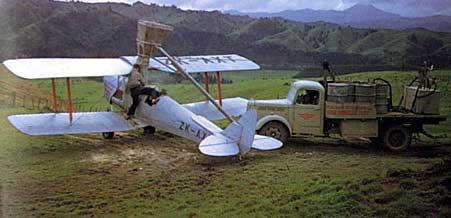 Many
were stored in my dad's lorry shed. See my ballad
Many
were stored in my dad's lorry shed. See my ballad  1989,
Come a Hot Friday
1989,
Come a Hot Friday