Alec Bennett and John Punch built this bridge in 1933 to transport logs from the west side of the Mangawhero river to their sawmill beside the main trunk railway line. 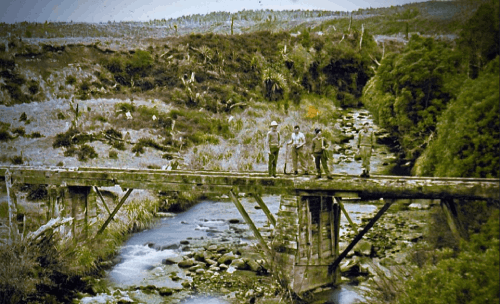 Bridge in 1961 with rails and sleepers removed after line closed. (colourised) 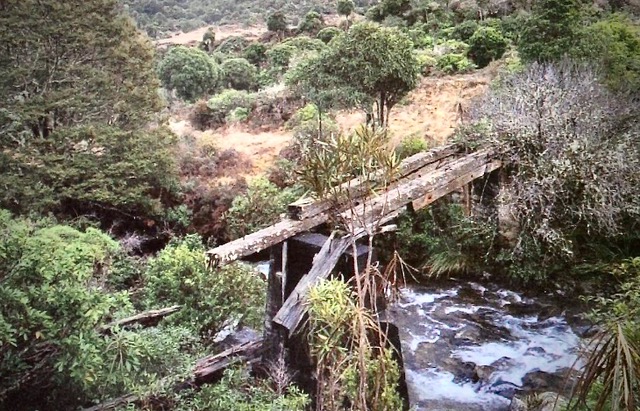 Bridge in 2023 In 1893 Alec Bennett and John Punch established a sawmill at Raetihi. In 1908 they shifted their mill to Rangataua and operated it until the bush was all cut out. In 1933 they opened a new mill at Dreadnought Road, between Rangataua and Ohakune. From here they put in a 3 foot 6 inch tramline, 8 kilometres up the lower slopes of Mount Ruapehu. They cut and milled timber until they ran out of logs in 1959. The Tramline In 1951 an inspector reported that the track was rather primitive: "Thirty-pound rails on unseasoned sleepers, laid with little regard to alignment or accuracy, while the roadbed consisted of longitudinal beams under the sleepers." And poorly maintained: "At the time of my visit, many of the spikes were loose, and shifting sleepers were not uncommon."
A log train derailed crossing this bridge and four men riding
home on the logs fell onto the rocks below.
The Tractors Over the years four tractors were used; three of these still exist. Earlier ones used 20hp McCormack Deering farm-tractor petrol engines, one remains upside down in the Mangawhero River after it ran away. The driver jumped clear. The last one was a Fordson diesel. They were mounted on a solid steel girder frame carried on large steel wheels.They were all built at the Union Foundry in Stratford. The chains to the front wheels gave engine braking on all 4 wheels coming down the mountain. There were also two big Judd steam haulers used in the bush. 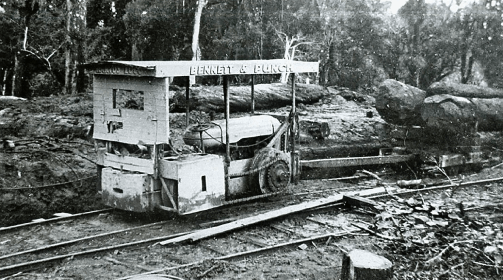 A
tractor in 1956 - one of the two log bogies can be
seen.
KIDS
 The tramway was in a straight a line as possible, with gentle curves and gradients. But this cycle trail has some sudden curves and steep climbs. Your challenge is to look out for the overgrown road of the old tramline when you come to one of these sudden changes in direction and or steepness. TEENAGERS Tread, trek, track, trail, tramp, tram have all developed from the old Germanic English word treden, to walk or take a step. An old wheelbarrow wheel used a wooden shaft called a trame to enable it to "walk" down a track, so timber-millers called a temporary rail-line made with lengths of wood a tramline, and still called it by that name when they used light steel rails for a temporary line, and they called its road, with cuttings, embankments and bridges, a tramway. Source
New Zealand Railway Observer,
Oct/Nov 2023
|
|||