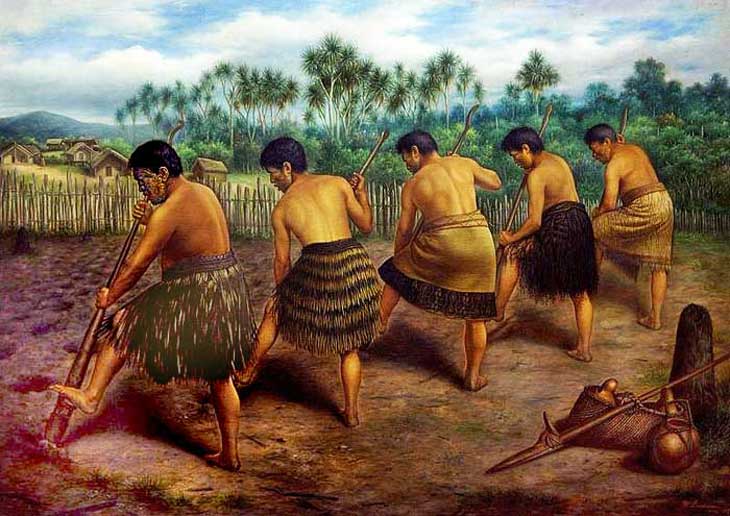
Elsdon Best
- 1925
The kumara or sweet potato (Ipomoea batatas) was the most
important of the cultivated food-products of the Maori
people of these isles. It was because of this fact that most
of the ceremonial associated with agriculture was connected
with this highly-prized tuber. In like manner, and probably
for the same reason, a number of myths and beliefs
became attached to it.
In Maori myth we see that Rongo was the origin, parent and
guardian of the sweet potato, as also of other vegetable
food-products; hence the saying:
“Ko Rongo-marae-roa te putake o
te kai, o nga hua o te whenua.”
Rongo-marae-roa was the
origin of food, of the fruits of the earth.
Pani was appealed to by planters of the sweet potato, that
she might bring them a bountiful crop. The Ngati Awa of
Whakatane state that Pani was the wife of one Rongo-maui.
Rongo-maui is said to have procured the
seed of the kumara from his elder brother Whanui, and Whanui
is the name of the star Vega, the star that is connected
with the harvesting of the kumara crop. In another
version Rongo-maui is replaced by one Maui-whare-kino.
Pani-tinaku is said to be mother of the
kumara; she gave birth to it in the misty past, and so she
occupies the place of Ceres (guardian of rice, wheat,
millet, oats) among these Polynesian folk without
grain crops.
The word tinaku is interesting; in Maori it denotes
cultivated ground, a garden, as well as seed-tubers of the
sweet potato, and also “to germinate.” In the Moriori
dialect of the Chatham Isles it means “to increase,” hence
its use as a secondary name for Pani. She was the
Germinator.
Pani is said to have been related to the Maui brothers, and
to have been their foster mother. We find in an old song the
following:—
“E tangi, e hine, kia whakarongo
mai Reikura, Reiaro, Reimaru … e
Nga tangata tena nana i
kai to ratau taina te kumara,
Te tama, e, a te tane
murimanu a Pani, a Tainui-a-rangi … e.”
Here Reikura and others are said to have eaten or destroyed
their young relative the kumara, the offspring of the
secondary husband of Pani, one Tainui-a-rangi.
The names of the children of Pani so produced are the names
of different varieties of kumara. A Tuhoe version of the
myth contains a statement that Pani was one and the same
personage as Taranga, the mother of the Maui brothers.
Pani means to smear mud in Maori today. Note that in Asia
pani is a variant form of pari and vari, both rice names,
and that vari is also used to denote water and mud. In India
pani is the word for water.
One of the important ceremonial acts pertaining to the
cultivation of the sweet potato was the planting of a few
tubers in a small plot of ground called the mara tautane.
This tapu planting was carried out with much solemnity, and
its purport was to secure the goodwill and help of the gods.
Each family or family group provided a few seed-tubers, and
these were ceremonially planted in the special plot by a
priestly expert. A ritual feast formed a part of this
function. This old, old ceremony is still followed by the
Tuhoe folk, or was some years ago, under the name of
huamata.
On the first of December these Tuhoe folk again assemble for
the ceremonial lifting of the tapu from the growing crops.
This is the pure rite, the amoamohanga or first-fruits rite.
The tubers produced by the special plot were utilized in the
ceremonial pertaining to the first-fruits rite.
According to one East Coast authority, men about to engage
in the tapu task of planting the sweet potato were careful
to array themselves in their fine garments, and not their
ordinary working garb. Also, the upper extremities of their
long spade-shafts were decorated with feathers for the
occasion. |