Te Maori exhibition, New York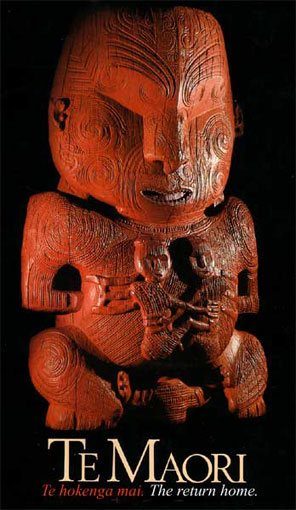
"I want you to come back with me to a September day,
1984. It's five o'clock in the morning. We're sitting on
the top step leading up to the illustrious Metropolitan
Museum of Art in New York - A slight puff of wind stirs
the enormous vertical banner towering above the doors
proclaiming, TE MAORI, MAORI ART!
The beginnings of TE MAORI go back several years. A team
of curators in New Zealand under the guidance of Maori
historian, author, carver and academic Professor Hirini
Moko Mead assess what objects would make up the
exhibition. Private and public collections are visited.
Gradually 174 prized and remarkable works of traditional
Maori art dating back to 1000 AD are assembled.
Works from thirty Maori tribes representing fifty types
of objects are brought together - monumental architectural
carvings - gateways, ridge poles, house posts and lintels,
elaborate canoe carvings, paddles and bailers, weapons,
musical instruments, tools, mortuary carvings and objects
of personal adornment. Wood, stone, jade, ivory, bone and
shell. The final selections are made by Douglas Newton,
(the Metropolitan's chairman of Primitive Art), Professor
Mead and Dr David Simmons, (Ethnologist at the Auckland
Museum.)
 Even
before TE MAORI leaves Aotearoa for New York, St Louis,
San Francisco and Chicago, it is being called "an
exhibition of Maori Art" - not - "an exhibition of Maori
artifacts". TE MAORI is being seen as the precious
outcomes of skilled artisans. Even
before TE MAORI leaves Aotearoa for New York, St Louis,
San Francisco and Chicago, it is being called "an
exhibition of Maori Art" - not - "an exhibition of Maori
artifacts". TE MAORI is being seen as the precious
outcomes of skilled artisans.
There is a glimmer of natural light. The Kaumatua group
has arrived - each member wearing prized heirloom cloaks
made of kiwi feathers with geometrical patterns made from
coloured feathers of other birds - tui, pigeon, kaka -
greenstone and whalebone ornaments are worn - many carry
ornately carved tokotoko - walking, or talking sticks.
The Karanga, the women's keening call of lamentations
ring out - 5th Avenue will never be the same- Kaumatua
intone incantations welling from solo voices to chorus.
The great double doors of the Metropolitan Museum Of Art
swing open ... the procession begins with grace and
dignity, slowly moves up the steps as we join it.
The successful Te
Maori exhibition opens at the Metropolitan Museum of Art
in New York in 1984, then tours several other United
States cities; St Louis, San Francisco and Chicago. Many,
many thousands of Americans respond enthusiastically."
Te Hokinga Mai
On its return to New Zealand, Te Maori was shown in the
main cities under the title "Te Maori. Te hokinga
mai. The return home" It was again well
received. While the taonga (treasures) were
created many generations ago, they are regarded as tupuna
(ancestors) to whom Maori are personally linked, and so
the taonga were appropriately accompanied by traditional
ritual welcomes. Consequently, each exhibition of the
taonga became an expression of te ao Maori (the
Maori world) as a vibrant, living culture.
Te Maori was a landmark event for Maori art and culture.
It sparked a new respect for taonga (treasures) in
museums and how they were displayed.
It also sparked a new respect for the Maori people by
Pakeha New Zealanders
 Outstanding art is ALMOST
symmetrical.
Outstanding art is ALMOST
symmetrical.
Tangi A Te Ruru
Associated most often with the night and the spirit
world, the haunting call of the morepork sent shivers of
foreboding down the spines of the early settlers of New
Zealand as well as the Maori who revered it as an
ancestral spirit. From ancient times till today the Maori
have incorporated the morepork's intense staring eyes into
their carvings. This stems from the myth of Rongo, a man
who built a carved dwelling from knowledge gained from a
house in the sky. He buried a tapu sacrifice near the rear
wall of this building; this was "Kou-ruru" or the
morepork. In remembrance of this event the bird is now
immortalized in the organic swirling artwork decorating
the buildings of the marae." (Jen
Longshaw)
The ancestor carved on the gable (kou) of a traditional
meeting house is given an owl-like visage to encourage us to
imitate their wise, wide-awake ways of living, as we follow
them into the dark unknown of the future.

|
 |
Ruru,
or New Zealand Morepork.
|
Koruru on NZ ten cent coin
|
Te Taite Cooper M.Ed, B.A, Dip
Maori.
Maori song writer, choreographer, performing arts and
spirituality specialist He was born in Hastings in 1940, and
educated at PakiPaki and Poukawa Primary Schools outside
Hastings, and Hato Paora College for three years.
In 1962 and 1963 he was based in Los Angeles as musical
director and choreographer for "Mauri Ora M?ori,"
a kapahaka group of six members that toured California and
Arizona doing one hour programs in Junior High Schools. Te
Taite and other Mauri Ora members lived in Vancouver,  Canada, from 1963 to 1985 and were used by the NZ government
to promote New Zealand tourism.
Canada, from 1963 to 1985 and were used by the NZ government
to promote New Zealand tourism.
He then returned to New Zealand and in 1986 co-wrote "Te
Hokinga Mai". He tutored at PakiPaki Bilingual school and
gave them many of his waiata. He wrote many songs for
different groups including Patea M?ori Club, and was
responsible for the M?ori repertoire of the New Zealand
National Youth Choir during their 1994 tour of North
America.
In 1992 he graduated at Victoria University, Wellington with
a Dip. M?ori and in 1994 with a B.A. in Education. He then
lectured teachers at Victoria University and Weltec, and in
his 70s he was an advisor to the ACC. He died in Wellington
in 2020.
Bishop Max Takuira Matthew Mariu SM CNZM
Mariu was born in Waihi on the southern shore of Lake
Taupo in 1952. He was educated at the convent school there,
and later at Hato Paora College, Feilding.
 He then joined the Society of Mary and studied for the
priesthood at Greenmeadows. He was ordained a priest in 1977
and did parish work at Napier and Whang?rei, and M?ori
pastoral care at Pakipaki. In 1980-81-22 he was on the staff
of Hato Paora College.
He then joined the Society of Mary and studied for the
priesthood at Greenmeadows. He was ordained a priest in 1977
and did parish work at Napier and Whang?rei, and M?ori
pastoral care at Pakipaki. In 1980-81-22 he was on the staff
of Hato Paora College.
At the age of 36 he became the first Catholic Maori to be
ordained a bishop. (Frederick Bennett was an Anglican bishop
in 1928)
His ordination on the marae in Tokoroa (or Waihi?) combined
M?ori and Catholic ritual.
In the 2002 New Year Honours, Mariu was appointed a
Companion of the New Zealand Order of Merit for services to
M?ori and the community. He died in Auckland in 2005 at the
age of 53 of a heart problem he had for some 30 years.
Pakipaki
 A k?inga village south-west of Hastings on the banks of
the (now highly polluted) Awanui stream at the site of the
kainga of his 16th century ancestress Hinetemoa. The full
name of the village, Te Pakipakitanga-o-Hinetemoa, recalls
how she huddled up there when surprised emerging naked after
bathing.
A k?inga village south-west of Hastings on the banks of
the (now highly polluted) Awanui stream at the site of the
kainga of his 16th century ancestress Hinetemoa. The full
name of the village, Te Pakipakitanga-o-Hinetemoa, recalls
how she huddled up there when surprised emerging naked after
bathing.
Pakipaki was established in the 1860s as the permanent
settlement of Ng?ti Whatui?piti, Ng?ti Ngarengare, Ng?ti
Papatuam?r?, Ng?ti Te Rehunga, and Ng?ti Tamater? back to
their ancestral land following 40 years of displacement to
Mahia during the Musket Wars.
Pakipaki is an ecumenical community represented by many
faiths. The predominant denominations of Christianity of
Pakipaki wh?nau families are the Catholic Katorika M?ori o
Te Ritenga, the Anglican H?hi Mihingare, and the R?tana
Movement. Wikipedia.
|
