|
Watersiders
The 1951 Waterfront Strike
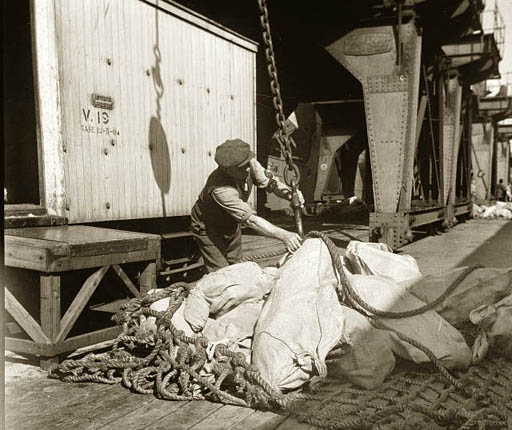
Watersiders or "wharfies" were labourers who loaded cargo onto the holds of ships in the days before 20 tonne shipping containers were lifted aboard with giant cranes onto a 200,000 tonne container ship. In the first half of the 20th century, New Zealand's main exports were bales of wool, carcases of frozen lamb and boxes of apples. These were moved by hand from railway trucks into rope slings, and the loaded sling was pulled up by a crane and lowered into the hold of a 10,000 ton cargo ship, where the wharfies stowed the bales, boxes or carcases.
It was hard work, but in the years after World War Two, watersiders and freezing workers received the highest wages in New Zealand, being paid about ten shillings (10/-) an hour. Other male laborers received 6/- to 7/-, while women workers received 3/- to 5/-. Even female schoolteachers with university degrees only received 7/- an hour. At that time you could take just one shilling to the corner shop and buy a bottle of milk, a loaf of bread, an apple and a newspaper. A new car cost about 10,000/-, a house 30,000/-.
From 1929 to 1950, sheep farmers on typical small farms had also put in long hours of hard work and had received low returns for their wool and fat lambs. Then in 1951 the price of wool trebled, bringing prosperity to the country.
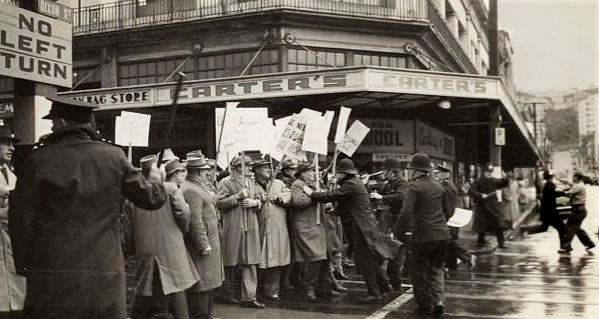
In January 1951 most workers were given a 15% wage rise, but the watersiders had already been given a wage rise a few months previously, and only got a 9% rise in 1951, so they refused to work overtime, when overtime was standard practice in summer for agricultural workers, who worked shorter hours in winter. They were then locked out of the wharves and other workers brought in. In effect, the watersiders were pawns in the struggle between international communism and international capitalism. Read more here.
Chris
Prouse
Chris Prouse is a Wellington accountant who specialises in arts management. A grandson of one of the watersiders involved in the 1951 strike, he is also folk guitarist and song-writer. In 2009 he produced an album of songs Trouble on the Waterfront, painting musical portraits of the sequence of events on 1951. In Feb 2010 it won the a Tui Award as the best commercial folk album of the year. You can listen to other tracks from the album HERE.
This webpage put on the NZ Folksong website in March 2010