
The original 1946 song.
|
|
Happy Rotorua version
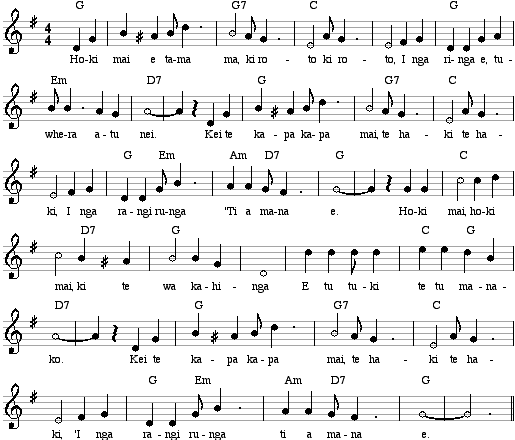
- Hoki mai e Tama ma ki roto, ki roto
I nga ringa e tuwhera atu nei,
Kei te kapakapa mai te haki, te haki
I nga rangi runga Tiamana e.
Chorus: x2
Hoki mai, hoki mai ki te wa kainga,
Kua tutuki te tumanako,
Kei te kapakapa mai te haki, te haki
I nga rangi i runga Tiamana e.
- Come back boys into, into
these arms outstretched here
as fluttering is the flag, the flag
in the skies over Germany.
Chorus x2
Come back, come back to the village life
Our wish has been fulfilled
as fluttering is the flag, the flag
in the skies over Germany.The tune is borrowed from a 1940s pop song, Goldmine in the Sky.
|
| Sons
of Aotearoa, now the day has been won And each foeman has been driven from the field Bring your banner to the fore, let it wave, proudly wave Let this symbol of your courage be revealed. Then return, then return, to your home o'er the sea With a prayer for peace and unity Let your standard be unfurled, to the fore, to the fore As an emblem of eternal liberty. |
... and a very mangled version!
These lyrics were sent to me by a rather puzzled choir leader in Australia, who had been given them from someone who had learnt them at a party in Auckland. The terakihi, (pronounced "teraki") is actually a common NZ fish! Other words here mean nothing at all. Be careful about what you learn at parties!
| Hoki
mai e tamama, teraki teraki Inga rangi etu pera atu nei, (atu nei) Kei te kapakapa mai teraki teraki Inga rangi rungo tia mana e Hoki mai, hoki mai kei te wa taringa Etu tuki te tumanako kei te kapakapa mai teraki teraki inga rungi rungo tia mana e |
Henare Waitoa 1910-1968
According to Henare's brother-in-law Maru Karaka, Tomo Mai e Tama Ma was composed and arranged by Henare the night before it was first performed. Apirana Ngata had requested a new song to welcome Peter Awatere and 'C' Company, who were returning home to the East Coast after nearly 6 years away at war. It was taught to Ngati Putaanga Kapa Haka only two hours before they went on stage at Ruatoria.
Henare Waitoa was born at Te Araroa on 13 April 1910. He was the son of the Reverend Paraire Rangihuna and his second wife, Te Wai Nepia, from Nuhaka. The Rev Rangihuna's birth father was Rota Huna, but he was one of eight whangai children raised by Reverend Hone Waitoa and his wife. Hone Waitoa was the missionary minister at Te Araroa at the time.
On his return he began In 1916 both Reverend Waitoa and his wife died, and Henare went to live with the eldest of Hone Waitoa's real children, Ema, who had married Michael Ryan, a Pakeha who worked at Te Araroa. Henare attended the native school at Te Araroa before studying at Te Aute College. He was only there for two years before realising that it was costing Ema and Michael Ryan more than they could afford, and so decided to leave farming.
Tikitiki war memorialIn 1931 he married Amiria Karaka from Mokonui. In 1936, after moving to Tawata near Tikitiki, he became a dairy farmer working on a farming cooperative scheme developed by Ta Apirana Ngata through what became the Department of Maori Affairs.
It is thought that Henare began composing songs around 1937. However, his most prolific period was during World War II. From 1939-1945 he mainly wrote music to help Apirana Ngata with his fundraising for the 28th Maori Battalion.
Henare Waitoa passed away peacefully on 28 January 1968 .
In 1972 Te Kapunga Dewes published a thesis (fully written in Maori) Nga waiata haka a Henare Waitoa o Ngati Porou about Henare Waitoa and his songs.

The Return of C Company
NEWS RECEIVED TODAY THAT THE GERMANS HAD SURRENDERED UNCONDITIONALLY TO THE ALLIES, AT 0241 HRS 7 MAY 1945.The Maori Battalion was in Northern Italy at the end of the war, helping persuade Tito that the port of Trieste did not belong to Yugoslavia.
Well before the first day of peace dawned the battalion marched to the parade ground and in complete silence waited the arrival of Padre Huata. Then, as at the end of so many campaigns, the troops sang the hymn 'Au E Ihu.'
Back in the battalion lines the Maoris set about breaking down the hostility of the Slav population. On 9 June an agreement was signed in Belgrade to withdraw all Yugoslav troops from the disputed area east of the Isonzo River, and the next two months were taken up with wharf and guard duties in Trieste.
Then the NZ Division was withdrawn from the Trieste area at the end of the month and made a leisurely move to Lake Trasimene.
In early September it was announced that memorial services would be held at war cemeteries near the principal battlefields and that Crete would be visited first.
of the Ngati Poneke Concert Party perform an action song
to welcome the returning warriors at Wellington.Colonel Henare was asked to detail the guard of honour, who would also act as the choir. Second-Lieutenant Wright and 24 other ranks from the different tribes and of the main religious denominations were selected and went into rigorous training in ceremonial rifle drill, haka, action songs and hymn singing; they embarked at Naples on 27 September and arrived at Suda Bay two days later. During the dedication ceremony, Padre Huata farewelled the Maori dead on behalf of the Maori people.
Similar ceremonies were later held at the Cassino and Sangro military cemeteries, and the men lying in smaller plots at Coriano Ridge, Faenza, Forli, Padua, Monfalcone and Udine were visited Padre Huata and a small party before the Maoris left Italy.
The Maori Battalion commenced its return to New Zealand on 6 December when it entrained at Florence then embarked on the Dominion Monarch at Taranto on 26 December.
The Dominion Monarch arrived in Wellington Harbour on 23 January 1946, and berthed just after midday at Pipitea Wharf, in almost the same berth as the Maori Battalion had departed from in the Aquitania nearly six years
previously.
lead the Maori Battalion through Wellington on its return from WW2The troops assembled on the wharf and were met with all the ceremony pertaining to the return of a war party in pre-pakeha days. Anania Amohau, a returned original member of the battalion, pranced and leapt towards Colonel Henare as between them the ancient ceremony of the wero was enacted.
Then women garlanded with greenery raised a tangi for those of the war party who would never return. And before the men could mingle with their people they had to be cleansed from the blood of their enemies and the tapu of the warrior had to be removed.
Hakas and action songs by the Ngati Poneke Maori Club preceded welcoming speeches. Then the troops moved into the quay shed and sat down to a real Maori meal.
------------------------------------------------------
Throughout the afternoon, trains carried the Maori soldiers to a hundred welcoming marae. A train carrying men of C Company would have arrived at Gisborne mid-morning on 24 January, and they would have arrived at Ruatoria that evening.
Published on folksong.org.nz September 25, 2001, modified Feb 2020

