NEW  ZEALAND
F
OLK * SONG
E Papā Waiari
Traditional

Maori Songs - Kiwi Songs - Home

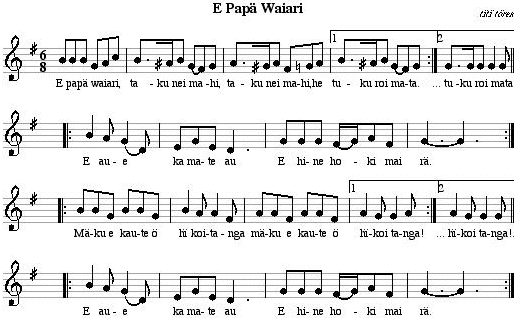
This tītī tōrea is sung while playing tī rakau, the Maori stick game. In olden times, stick games trained young men in spear fighting, and traditional tītī tōrea were chanted.

In the USA it has sometimes been taught to Girl Scouts as "lemmi sticks," confusing it with a traditional gambling game of the Lummi and other North-western tribes in which similar sticks are used. See below


Despite the dropped sticks and the screams of laughter, these
ladies from a Wellington choir on a visit the USA are giving a
good demonstration to a group in Kansas of the traditional actions.
They are also singing the song as a round. Well done ladies.

E hine, hoki mai ra.

1. E papā Waiari,
Taku nei mahi
Taku nei mahi,
He tuku roimata

Chorus:
Ē aue, ka mate au;
E hine hoki mai rā
Ē aue, ka mate au;
E hine hoki mai rā

2. Māku e kaute
Ō hīkoitanga
Māku e kaute
Ō hīkoitanga

Chorus:

Oh darling, come back to me.

1. O Uncle Waiari,
All I've been doing
All I've been doing
Is shedding tears

Chorus:
Alas I will die;
Oh darling, return to me
Alas I will die;
Oh darling, return to me
 
2. I will count
Your footsteps
I will count
Your footsteps
Chorus:


Chords

G E hine, D7 hoki mai G ra.

1. E papā Waiari,
Taku nei mahi
D7 Taku nei mahi,
He G tuku roimata

Chorus:
Ē aue, ka C mate G au;
E hine D7 hoki mai G
Ē aue, ka C mate G au;
E hine D7 hoki mai G

2. Māku e kaute
Ō D7 hīkoitanga
Māku e kaute
Ō G hīkoitanga


Play this 1 K Midi tune.

Tī Rākau Stick Games


These games consist of the rhythmic throwing and catching of sticks from person to person.

In olden times:

In more recent times:

Stick game songs are called waiata poi rākau or tītī tōrea. The game and song, "Titi-Torea" can be found on pages 74-77 in Games for Girl Scouts, published by Girl Scouts of the USA.

Another well-known tītī tōrea on this website is Hurihuri

Here is part of a traditional tītī tōrea, recorded by Mervyn McLean (McL 805A)

Musical  notation and chords for E Papa. Size = 12K

Play this 1 K Midi chant.

Ma koo way

The words of the second verse of this song are sometimes used in the USA, in a phonetic form as
Ma koo ay, ko tay o, ay koo ee tah-nah, or Ma ko way, ko tay oh, way koey tanna.

Ma
koo
ay,
ko
tay
o,
ay
koo
ee
tah
nah
Ma
ku
e,
kau
te
o,
hi
ko
i
ta
nga
Ma-ku e, kau-te o, hi-ko-i-ta-nga
Māku e, kaute ō, hīkoitanga

Please note that this American pronuniation is incorrect.

This is closer to the correct Maori pronunciation.
Ma
ku
e,
kau
te
o,
hi
ko
i
ta
nga
Ma
koo
air,
kow
tair
or,
hi
koo
ee
tah
ngah

Ma koo ay Instructions for playing the game can be found here also.

You can help NZ Folksong
For the past ten years I have been paying all the research and operating costs of this website from my monthly pension. Actrix internet company is now running my site for free, bless them, but I still have considerable research and maintence costs. You may wish to help with a secure contribution by credit card or Paypal.

Lemmi Sticks

The song E Papa Waiari, and its stick game directions, can be found on pages 74-77 as "Titi-Torea" in Games for Girl Scouts, published by Girl Scouts of the USA. But this game is sometimes wrongly called "Lemmi sticks" by USA Girl Scouts. This name is derived from the term Lummi sticks which is the name given by whites to the traditional American gambling game of Slahal played by Lummi and other Salishan tribes on the Washington-Vancouver border.

The Lummi Nation

Abbreviated from Nuglummi = 'us people.'

The Lummi people form the principal tribe of more than twenty small Salishan tribes originally holding the lower shores of Puget Sound, Washington.

They occupied several villages about the mouth of Lummi river, Whatcom County. Their language and culture is the approximately the same as that of other tribes on the Washington-Vancouver border, the Samish, Klalam, Semiamu, Songish, Sanetch, and Sooke.

In her excellent 1975 monograph, ethnomusicologist Wendy B. Stuart says gambling songs have an integral part of the Salishan tribal tradition since aboriginal times and have been maintained and preserved by oral means. Slahal, or the bone game, is of interest because of the ancient music which accompanies it.


Click for full-size picture
- Full details
Slahal requires two pairs of cylindrical bone sections to be concealed in the hands. Each pair of bones consists of one marked and one unmarked bone. During the game, the bones are hidden in the hands while being mixed by two different individuals from one team, each manipulating one pair. The object of the game is that the opposite team guess the position of the unmarked bones.

Large amounts of money may be bet on the outcome of the game. There are 11 chopstick-sized twigs used as counters. And batons similar to those used in the Maori stick game are used by other team members to beat a rhythm on a long plank. In this 1946 photo, you can see one of the game bones in the open hand of one player. Click on it to see the original photo. You can also see women playing the stick game in 1925 by clicking here.

Wendy B. Stuart says that on the average, slahal songs have about 4 beats per second,which after some hours produce a trance-like state. In other words, the musical aspects of slahal lift it from the realm of an ordinary gambling game into something far more exciting.

There is an excellent brief explanation on how to teach children the guessing game of Slahal here. And instructions for teaching the rhythmic stick-beating chant are here.

A note to leaders of Girl Scouts in the USA

It is great to see that so many of you are teaching Maori stick games. But please do not teach your girls the mangled version of E Papa Waiari that is on some internet pages and tell them it is a Red Indian/Native American tune from the "Lemmi tribe." Here is the score of some real Lummi stick music.


Maori Songs - Kiwi Songs - Home


Published on the web 12 June, 2001. Lemmi sticks details added Feb 2003,
Tidied up May 2005. YouTube video added March 2008