The
stock market crash of 1929 led to the great depression of 1931,
putting 50,000 New Zealand men out of a job.
Wandering
above a sea of glass
in the soft April weather,
Wandering through the yellow grass
where the sheep stand and blether.
Roaming the cliffs in the morning light, hearing the gulls that cry there,
Not knowing where I'll sleep tonight, not much caring, either.
I haven't got a stiver
the tractor's pinched m' job,
I owe the bar a fiver
and the barman fifteen bob;
The good times are all over,
the monkey-man has foreclosed,
M' woman's gone with the drover,
not being what I supposed.
Roaming the cliffs in the morning light, hearing the gulls that cry there,
Not knowing where I'll sleep tonight, not much caring, either.
I
used to get things spinning,
I used t' dress like a lord,
Mostly I came out winning,
but all that's gone by the board.
M' pants have lost their creases,
I've fallen down on my luck,
The world has dropped to pieces
everything's come unstuck.
Roaming the cliffs in the morning light, hearing the gulls that cry there,
Not knowing where I'll sleep tonight, not much caring either.
Wandering above a sea of glass
in the soft April weather,
Wandering through the yellow grass
close to the end of my tether.
Soft
April weather
April
in New Zealand is early autumn, with the weather
still warm, food plentiful and some seasonal farm
jobs available. But winter is close at hand. For
this unemployed man, his options were running out.
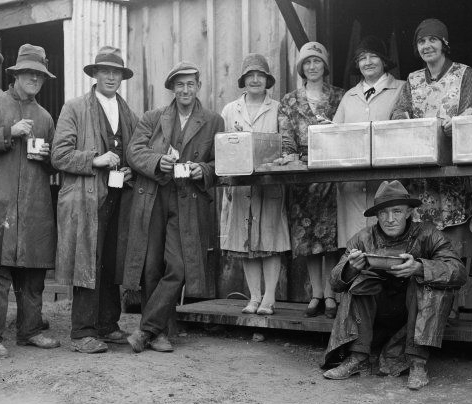
Over winter he would have to face the humility of
getting hand-out meals from a soup kitchen and
sleeping rough.
Stiver,
fiver, fifteen bob
"I
havent got a stiver" "I haven't even got ten
cents." A stiver was an insignificant amount of
money. A fiver was five Pounds, about a week's
wages in 1930. One Pound was equal to 20
shillings, and "fifteen bob" was 15 shillings,
about six hours wages.
The
tractor's pinched m' job
There were only a few industrial jobs in NZ in the
early 20th century. Most men worked on farms. But
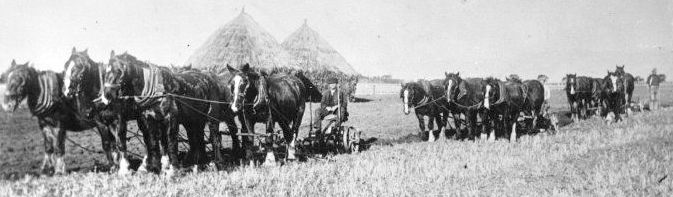
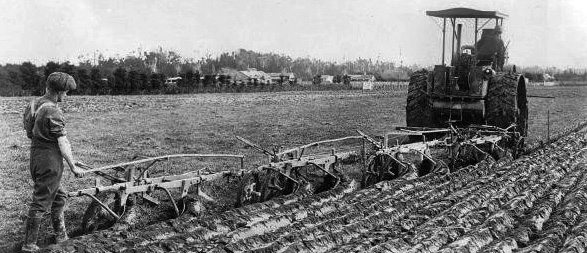
farms were becoming mechanized. Farmers had
prevoiusly employed many men to guide the horses
that ploughed the land for crops. One tractor
driver could plough as much land as several horse
ploughmen. Similarly shearing machines and milking
machines reduced the number of workers needed for
those labour-intensive occupations.
In
the 1890s it took 20 to 25 hours of labour to
produce 50 bushels of wheat (1.4 tonnes) on one
hectare, using horses, plough, seeder, harrow,
binder, thresher, and wagons. By 1930, it took
only 7 to 10 man-hours to produce the same amount
of wheat using a tractor, plow, discs, harrow,
combine and trucks.
The
monkey-man has foreclosed
A home or small business can be financed with a
mortgage loan from a bank or a loan company. But a
loan is like a monkey on your back; it's easy to
get it there, but difficult to get rid of. If you
can't pay the loan, the monkey-man reposses your
house.
When
British soldiers were in India in the 19th
century, the 500 Rupee banknote had a picture of
monkeys on it. So when they returned to England,
they called 500 Pounds "a monkey." And a mortgage
loan for a house was typically about 500 Pounds.
M'uh
woman's run off with the drover.
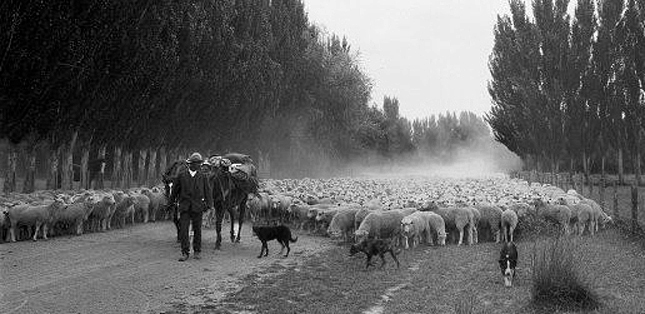
Today sheep are taken to the freezing works in
crates on 40-ton trucks. But even as late as 1950,
drovers guided flocks of sheep along the back
country roads to the nearest railway station. The
sheep walked slowly, perhaps 15 km a day, grazing
on the roadside as they went. This is why roadways
were 20 metres wide, with wide grass strips beside
the gravelled highway. (The roadway north of
Feilding is 40 metres wide. They brought big
flocks of sheep down that road.)
There were public holding paddocks every 15 km or
so. They were usually overgrazed and full of
dog-daisy. Our local drover at Mangamahu had a
horse-drawn, rubber-tyred gig and several dogs,
but some drovers rode on horseback, with their
gear on a packhorse.
Down on My Luck, on record
1967, Fernfire Singers Sweat in the Sun,
Mate! LP
1980, Graham Wilson, Paydirt, LP
1993,
Rudy Sunde, Songs of New Zealand, CD
2009,
Brent Morrissey, Echoes in a Trackless Land,
CD
This
song has also been part of Dave Hart's repertoire
for several decades.
Composer
of the lyrics of Down On My Luck (above) and Walking
On My Feet (below), Rex Fairburn was a major New
Zealand poet of the 1920s - 50s. He was a fourth-generation
New Zealander: his great-grandfather being a missionary, his
grandfather an eccentric critic of society and his father an
Auckland businessman.
Rex attended Auckland Grammar 1918 - 20, leaving it without
academic qualifications. He then worked as an insurance
clerk for six years. He was unemployed from 1926 until 1930,
but did some freelance writing, winning a poetry prize in
1929. In 1930 he went to England. It was a time of
intellectual searching as he formulated his personal
philosophy there; a mixture of Douglas Social Credit,
vitalism, and back-to-nature organic farming.
In 1932 he returned to New Zealand with a wife and child but
he was unable to find paid employment, and for three years
he experienced at first hand the relief gang work he
depicted in later poems. He began publishing poems and
articles in the late 1930s, and also worked with the
Farmers' Union, a Social Credit organisation, helping to
edit its journal, Farming First. He served in the army 1942
- 43, and then was manpowered into work with radio station
1ZB as a scriptwriter.
In 1948 he became a tutor in the Department of English at
Auckland University College, and in 1950 lecturer in the
history of fine arts at the University's Elam School of Art.
He was also active as an editor in these years. His career
was cut short by his death from cancer in 1957.
Ballads of his such as Walking on My Feet and Down on My
Luck were among his most successful works, with the
anonymous speakers taking on a role like that of Harry in
Glover's Sings Harry poems. Fairburn's easy command of
rhythm and prosodic effects, his image-making ability, and
his control of a middle range of diction, neither vernacular
nor consciously poetic, result in poems with great emotional
resonance, lucid, direct and deceptively simple.