|

|
from "Hunger in the Air," by Phil Garland, 1987
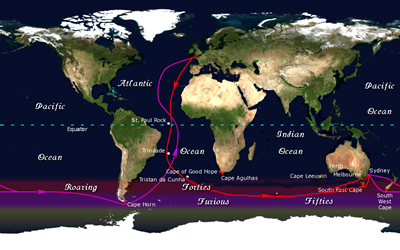
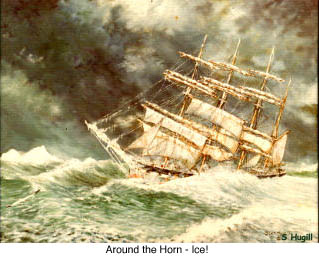
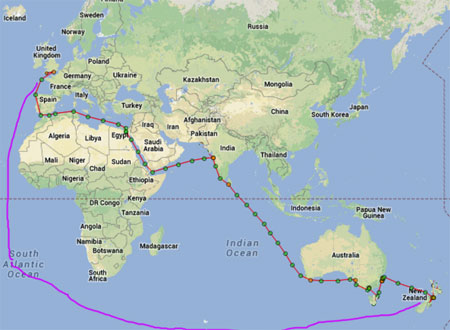
Rio Grande and Shanghai. 2. Beneath the kauri trees. The huge old kauris grow in Northland and Coromandel in New Zealand. The sailor was probably whaling out of 1830s Kororareka in Northland. 3. Where they call you mate. Australia. Sealers were working out of Sydney harbour. But see 13 below. 4. Around the Horn. Cape Horn is at the bottom of South America. Before the Panama Canal was built, this was the sea route from the Pacific to the Atlantic Ocean. Very cold and stormy. 5. Across the Line. The Equator, a line on the map. Hot and often windless. Sailing ships could be becalmed for days on end. 6. The Gulf Stream. A strong nor-easterly current flowing out of the Gulf of Mexico and up the eastern cost of the USA. 7. Table Bay. A natural harbour overlooked by Cape Town near the Cape of Good Hope at the bottom of Arfica. Before the Suez Canal was built, this was the sea route from the Atlantic to the Indian Ocean, with a run downwind to New Zealand. 8. Row-lock. It gives leverage to your oar. Pronounce it as "rollick." 9. Stewart. Stewart Island is below New Zealand's two other bigger islands. Wild, wet, windy, cold. 10. The Strait is Foveaux Strait between Stewart Island and the South Island of NZ. A rough and dangerous stretch of water. Sealers were working in this area in the early 1800s. 11. Milford Sound. Sheltered harbour for sealers, 200 nautical miles nor'west of Foveaux Strait. 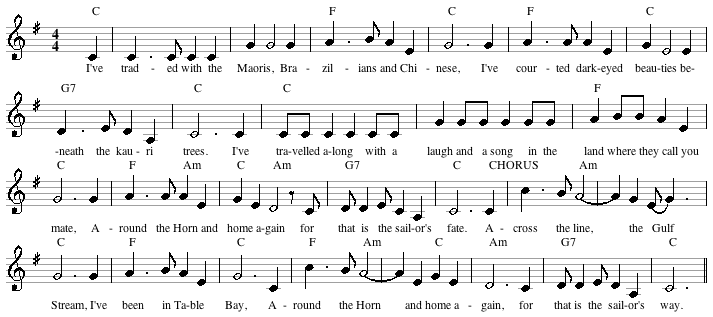
|
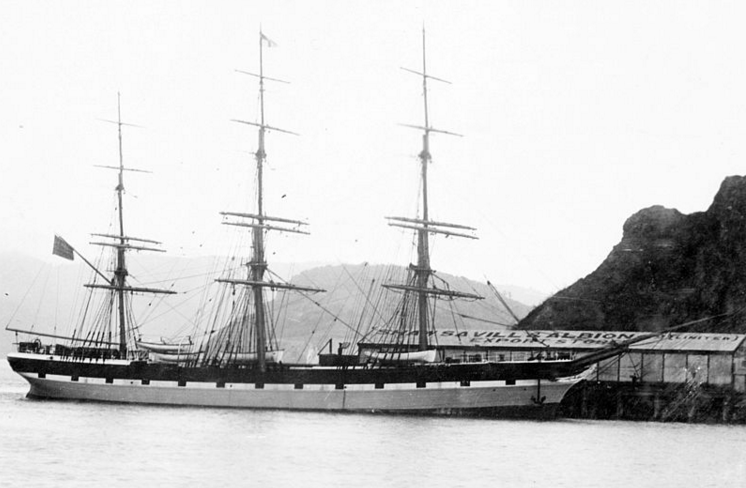
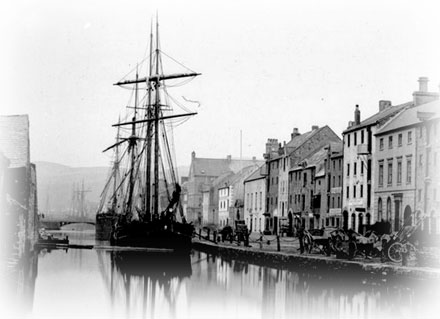
|
HOMEWARD BOUND Head the ship for England, shake out every sail Blithe leap the billows, merry sings the gale Captain, work the reck'ning, how many knots a day? Round the world and home again, that's the sailor's way! We've traded with the Yankees, Brazilians, and Chinese We've laugh'd with dusky beauties, in shade of tall palm trees Across the Line and Gulf-stream, round by Table Bay Everywhere and home again, that's the sailor's way! Nightly stands the North Star, higher on our bow; Straight we run for England, our thoughts are in it now. Jolly time with friends on shore, when we've drawn our pay All about and home again, that's the sailor's way! Tom will to his parents, Jack will to his dear Joe to wife and children, Bob to pipes and beer Dicky to the dancing-room, to hear the fiddles play Round the world and home again, That's the sailor's way! |
2. The Sailor's Way
We've courted
gay Peruvian girls and French girls and
Chinese
Spanish girls and Dutch girls and dainty
Japanese
To far Australia and Honolulu where the
Hawaiian maidens play
A different girl in every port for that's
the sailor's way
O shining is the north star as it hangs off
our starboard bow
We're homeward bound for Liverpool town and
our hearts are in it now
for we've crossed the line and the gulf
stream, been round by Table Bay
Around the Horn and home again, for that's
the sailor's way
And it's goodbye to Deirdre, we're off to
sea once more
Sailor Jack always comes back to the gals he
do adore
He'll cross the line and the gulf stream, go
round by Table Bay
Around the Horn and home again for that's
the sailor's way
In calm or storm or rain or shine the
shellback doesn't mind
On the ocean swell he works like hell for
the gal he's left behind
He beats it north, he runs far south, he
doesn't get much pay
He's always on a losing game, for that's the
sailor's way
We'll get paid off in Liverpool and go out
on a spree
We'll eat and drink and have some fun and
forget the bloody sea
And Jack will go with his sweet Marie and
Pat with his 'Cushla play
But I'll get drunk and turn in me bunk for
that's the sailor's way
And it's goodbye to Maggie, we're off to sea
once more
Sailor Jack always comes back to the gals he
do adore
He'll cross the line and the gulf stream, go
round by Table Bay
Around the Horn and home again for that's
the sailor's way
1870s - Steam and the Suez Canal
By 1870,
steam ships could travel faster for longer distances,
thanks to hgher boiler pressures, compound steam engines
and stronger, lighter hull designs. They needed only 20
tonnes of coal to travel 450 km in one day.
And the Suez canal had opened for steamships, cutting 7000
km off the trip around the bottom of Africa. The steam
ships returned to England the same Suez route. The days of
the Roaring Forties and Cape Horn were coming to an end.
3. Yellow Girls
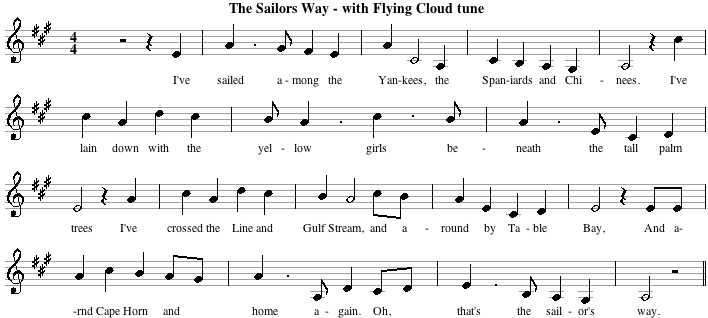
There is a version from Nova Scotia, collected by William Doerflinger in 1930, set to the tune of the epic slave ship chanty The Flying Cloud. It is in his 1951 songbook, Shantymen and Shantyboys.
|
I've sailed among the Yankees, the
Spaniards and Chinese. I've lain down with the yellow girls beneath the tall palm trees. I've crossed the Line and Gulf Stream, and around by Table Bay, And around Cape Horn and home again. Oh, that's the sailor's way! Oh, Bobby'll go to his darling, and Johnny'll go to his dear, And Mike will go to his wife and fam'ly, and Andrew for pipes and beer; But I'll go to the dance hall to hear the music play, For around Cape Horn and home again, oh, that is the sailor's way! |
4. 1900s - Nostagia
Topsail men moved to the bigger, slower, steel-hulled windjammer cargo vessels, and then to smaller coastal schooners.
Waterfront
journalist James Cowan collected this song telling of
romantic voyages long ago. He published it in his The
Bush Poet article in 'The Canterbury Times', 24
September 1913.
Yankees have become Maoris, and yellow girls under
tropical palm trees have become part-European girls in New
Zealand's Northland.
| "I've
traded with the Maoris, Brazilians
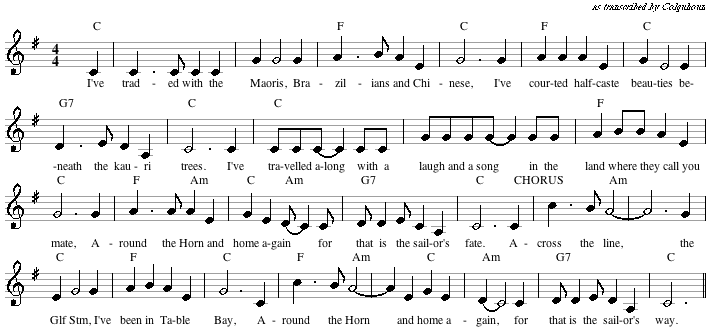
and Chinese, I've courted half-caste beauties beneath the kauri trees;12 I've travelled along with a laugh and a song In the land where they grow "mate",13 Around the Horn and home again, For that is the sailor's way. Chorus I've crossed the Line, the Gulf Stream, I've been in Table Bay; Around the Horn and Home again, For that is the sailor's way!" |
12. Half-caste beauties beneath the kauri trees. From 1789 on, sailing ships visited the Kaipara Harbour for cargos of kauri timber to use for ships masts and spars. The half-caste beauties were the daughters of Maori women and earlier European sailors.
13. Mate is yerba maté. Apparently it is correctly pronounced as "mo-TA," but was probably sung as "mar-tay" in this version, to rhyme with "sailor's way." Yerba maté is a tea made from the leaf of Ilex paraguariensis, the Paraguayian holly, and is widely drunk throughout South America for its pick-me-up caffeine properties. Paraguay is of course land-locked, but yerba maté is also grown in Brazil and Argentina. So the sailor had spent time ashore when his ship docked in Buenos Aires
In his same 1913 Canterbury Times article, Cowan also mentioned a version of this song heard on coastal vessels in the Auckland region. It had these variant lines.
| Eastward
round by Dusky Sound, and Pegasus - through the
Strait, Port Cooper, Ocean, Tom Kain's Bay, for that is the coaster's fate. |
Sam
Sampson writes:
"Dusky Sound is a rather remote part of the SW corner of
the South Island of NZ.
"Port Pegasus is at the south end of Stewart Island, and
Foveaux Strait at the north end of the island. If the
weather was OK, the sailing ships took the shorter route
through the Strait - if shitty they went south into
rougher water - but at least there was searoom out
there."
Port
Cooper (Lyttlton Harbour, near Christchurch), Tom Kain's Bay
(O'Kains Bay near Akaroa) and Ocean Bay (near Blenheim) are
on the east coast.
5. Colquhoun version
In the 1950s Neil Colquhoun recorded this song, using Cowan's words published in 1913, and a tune by Wellington folkie Jim Delahunty. It was published in "Songs of a Young Country" in 1965, and you can see and hear a few differences from today's rendering of it.
6. Chants De Marins: Sea Shanties from Dublin to Auckland
Rudy Sunde and his Auckland maritime mates recorded this version, on a CD released in France.
|
I've
traded with the Maoris, Brazilians, and Chinese. I've courted dark-eyed beauties beneath the kauri trees. I've traveled along with a laugh and song in a land where they call you mate, Around the Horn and home again, for that is the sailor's fate. CHORUS: I've crossed the Line and Gulf Stream, been round to Table Bay Around the Horn and home again, for that is the sailor's way. I've run aground in many a sound without a pilot aboard. Longboat lowered by candlelight, pushed off and gently oared. Rollicks creaking, a thumping swell, a wind that would make you ache. Who would sail the seven seas and share in a sailor's fate? CHORUS I've sailed out to the northward. I've sailed out to the east. I've stripped the sail in many a gale, and stood in the calmest seas. Eastward bound by Dusky Sound, and Pegasus through the straits. Port Cooper, Ocean, Tom Kain Bay, for that is the coaster's fate. CHORUS |
7. Bellowhead's half-remembered 2006 version
Their tune was borrowed from Clube Da Esquina No. 2 by Milton Nascimento, and their words were half-remembered by Jon Boden from a shanty album he had listened to a decade previously.
|
I've sailed the whole world over, across the
seven seas,
Across the barren wasteland of the frozen Arctic
sea, We sailed up to the northward, we sailed up to
the east, |
ABC notation
T:Across the Line
M:4/4
L:1/4
Q:100
K:G
"C"C|C>CCC| GG2G|"F"A3/ B/ A E|"C"G3G|"F"A3/A/AE| "C"GE2E|
"G7"D3/E/DA,|"C"C3 C|"C"C/C/ CC C/C/|GG/G/G G/G/|"F"AB/B/AE|
"C"G3G|"F"A3/A/"Am"AE|"C"GE"Am"D2z/C/|"G7"D/DE/CA,|"C"C3"CHORUS"C|c3/B/"Am"(A2|A)G(EG)|
"C"G3G|"F"ABAE|"C"G3 C|"F"c3/B/"Am"(A2|A)E"C"GE|"Am"D3C|"G7"D/DE/DA,|"C"C3|| .
Song List - Home
Published on the web September 25, 2001, updated August 2006, revised 2015.